Chapter 12: Part B, Steering and Sailing Rules (Rules 4 to 19)
Part B is split by visibility state (Chapter 5): Section I (Rules 4–10) applies in any visibility and qualifies the rest; Section II (Rules 11–18) applies to vessels in sight of one another; Section III (Rule 19) applies in restricted visibility. The first question in any encounter is which section governs.
Section I: Conduct of Vessels in Any Condition of Visibility
Rule 4: Application · CONCISE
A single structural sentence: the Rules of this Section apply in any condition of visibility. Rules 5 to 10 run in clear weather, fog, rain and darkness alike, and they operate alongside whichever of Section II or Section III applies. They never switch off. See: Ch 5 (Section I as the always-on layer).
The rule’s text, word for word and annotated: Rule 4 in Appendix B.
Rule 5: Look-out · FULL
An absolute obligation written with no softening: every vessel, at all times, shall maintain a proper look-out by sight and hearing and by all available means appropriate in the prevailing circumstances. The duty is cumulative, not alternative: sight and hearing and radar and AIS and a VHF watch, as the conditions warrant. Its purpose is not bare detection but a full appraisal of the situation and of the risk of collision, which is why a look-out that sees a contact but fails to assess its risk is still a poor look-out.
PRACTICAL NOTE: the dedicated look-out
When the workload is high the OOW cannot keep a proper look-out and con the ship at once. In confined waters, heavy traffic or restricted visibility, good seamanship requires a dedicated look-out separate from the OOW. Failing to post one is a Rule 5 breach reached through Rule 2.
Interactions: Rule 5 feeds Rule 7 (the look-out is how risk of collision is determined) and underlies every encounter Rule; a breach of Rule 5 is almost always pleaded alongside whatever situational Rule was broken. See: Ch 8 (risk of collision), Ch 6 (“at all times” as a continuous duty).
The rule’s text, word for word and annotated: Rule 5 in Appendix B.
Rule 6: Safe Speed · FULL
Safe speed is defined by what it must achieve, not by a number: a speed at which the vessel can take proper and effective action to avoid collision and be stopped within a distance appropriate to the conditions. Both at once. The Rule lists the factors to weigh, visibility, traffic density, the vessel’s own manoeuvrability and stopping distance, background light, the state of wind, sea and current, draught against depth, and a further set for radar-fitted vessels, and the list is expressly not exhaustive.
PRACTICAL NOTE: the stopping-distance test in fog
A workable test in restricted visibility: can you stop within the range at which you can detect the smallest relevant target? If small craft show on your radar at two miles but your stopping distance is three, you are not at a safe speed, whatever the number on the log.
DRAFTING ISSUE: no defined speed
Safe speed is entirely relative and is assessed by a court retrospectively. If the vessel could not stop or manoeuvre in time, she was, by definition, not at a safe speed. Chapter 9 explains why no figure could have been written in.
Interactions: Rule 6 conditions every manoeuvre under Rule 8 and is restated for restricted visibility in Rule 19(b); it is one of the Section I Rules that qualify Sections II and III. See: Ch 7 (safe speed as an undefined term), Ch 5 (Section I qualifies the rest).
The rule’s text, word for word and annotated: Rule 6 in Appendix B.
Rule 7: Risk of Collision · FULL
Rule 7 is what switches the encounter Rules on. Until risk of collision exists, none of them apply and no vessel is give-way or stand-on (Chapter 8). The Rule both directs how to determine risk and pre-decides the doubtful case. Risk is determined by all available means appropriate to the conditions, with proper use of radar including long-range scanning and plotting (7(b)), and no assumptions on scanty information, especially scanty radar information (7(c)). Then the deeming provisions: if there is any doubt, risk shall be deemed to exist (7(a)); risk is deemed to exist if the compass bearing of an approaching vessel does not appreciably change (7(d)(i)); and risk may exist even with an appreciable bearing change when approaching a very large vessel or a tow, or at close range (7(d)(ii)).
TRANSLATION
Rule 7(a) (MISCPUB 0127): “Every vessel shall use all available means appropriate to the prevailing circumstances and conditions to determine if risk of collision exists. If there is any doubt such risk shall be deemed to exist.”
Plain reading: use everything you have to work out if you’re standing into danger, and if you’re not sure, treat it as a yes.
What the legal wording does that the plain version can’t: “shall be deemed to exist” closes the question. You do not get to wait for certainty; doubt itself triggers the duty to act, which is why “I wasn’t sure” is no defence (Chapter 6).
Interactions: Rule 7 is the trigger for Rules 12, 14, 15 and 19(d)/(e), and by implication for Rules 16, 17, 18 and 34; the one situation that does not need it is overtaking under Rule 13, which engages on geometry alone. See: Ch 8 (the gate of risk of collision), Ch 6 (deeming and the safe presumption).
The rule’s text, word for word and annotated: Rule 7 in Appendix B.
Rule 8: Action to Avoid Collision · FULL
Rule 8 is the method Rule: not who acts, but how. Action shall be positive, made in ample time and with due regard to good seamanship (8(a)); an alteration shall be large enough to be readily apparent visually or by radar, and a succession of small alterations is to be avoided (8(b)); a bold alteration of course alone is often best if there is sea room (8(c)); action must result in passing at a safe distance, checked until finally past and clear (8(d)); and a vessel shall slacken speed or take all way off if necessary (8(e)). Rule 8(f) is the bridge between the not-impede and the keep-out-of-the-way frameworks (Chapter 8): when a not-impede situation escalates to risk of collision, both apply at once, and neither the burdened vessel nor the one whose passage was not to be impeded is relieved of the encounter Rules.
PRACTICAL NOTE: what “substantial” means
Read with Rule 16, the bold-action requirement of 8(b) usually means an alteration of at least 30 degrees, preferably more, and any speed reduction must be large enough to register on the other vessel’s radar. A 10-degree nudge is the classic finding of fault. The manoeuvre is a signal; make it readable (Chapter 1).
Interactions: Rule 8 governs the manner of every avoiding action under Rules 13–19; 8(d)’s “finally past and clear” links to Rule 13(d); 8(f) coordinates with Rules 9, 10 and 18’s not-impede provisions. See: Ch 8 (the two frameworks and Rule 8(f)), Ch 1 (legible action).
The rule’s text, word for word and annotated: Rule 8 in Appendix B.
Rule 9: Narrow Channels · FULL
A vessel proceeding along a narrow channel keeps as near to the outer limit on her starboard side as is safe and practicable (9(a)). A vessel under 20 metres or a sailing vessel shall not impede a vessel that can navigate only within the channel (9(b)); a fishing vessel shall not impede any vessel in the channel (9(c)); and no vessel shall cross if to do so impedes such a vessel (9(d)). The overtaking protocol of 9(e) requires the overtaking vessel to signal her intention and the overtaken vessel to agree before passing, using the Rule 34(c) signals, but does not relieve the overtaking vessel of her Rule 13 duty. A vessel nearing a blind bend navigates with particular alertness and caution and sounds one prolonged blast (9(f), Rule 34(e)).
PRACTICAL NOTE: what makes a channel narrow
“Narrow” is relative to the vessels in it. A channel is narrow where a vessel using it is constrained in her ability to deviate. A 400-metre tanker is constrained where a 30-metre vessel has room to spare, so the same water can be a narrow channel for one and open for the other (Chapter 7).
Interactions: Rule 9 is one of the three Rules (with 10 and 13) that Rule 18 yields to; its not-impede duties run through Rule 8(f); it overlaps with Rule 10 where a TSS lies in a channel (see the drafting issue at Rule 10). See: Ch 9 (the Rule 9/10 overlap), Ch 8 (not-impede vs keep-out).
The rule’s text, word for word and annotated: Rule 9 in Appendix B.
Rule 10: Traffic Separation Schemes · FULL
The first sentence is the one to fix: Rule 10 does not relieve any vessel of her obligation under any other Rule. The encounter Rules run inside a scheme exactly as outside it. A vessel using a scheme proceeds in the appropriate lane in the general direction of flow, keeps clear of the separation zone, and joins or leaves at the ends or at as small an angle as practicable (10(b)). A vessel crossing a lane does so, so far as practicable, on a heading as near to a right angle as practicable, note heading, not course over the ground (10(c)). Inshore traffic zones are not to be used when the lane can be safely used, with stated exceptions (10(d)). Fishing vessels and vessels under 20 metres or under sail shall not impede vessels following a lane (10(i), (j)).
DRAFTING ISSUE: Rule 9 and Rule 10 overlap
Where a scheme lies within a narrow channel both Rules apply at once, and they can pull against each other: Rule 10(c) says cross at right angles, Rule 9(d) says do not cross if it impedes a confined vessel, and the text sets no hierarchy. In practice the routeing measure takes priority for lane discipline while Rule 9’s keep-to-starboard governs within the lane, but that is convention, not text (Chapter 9).
Interactions: like Rule 9, Rule 10 is a Rule that Rule 18 yields to; its not-impede duties run through Rule 8(f); Rule 10(d)(ii)’s “notwithstanding” is a narrow internal override. See: Ch 9 (the overlap), Ch 5 (Rule 10 as a 1972 addition).
The rule’s text, word for word and annotated: Rule 10 in Appendix B.
Section II: Conduct of Vessels in Sight of One Another
Rule 11: Application · CONCISE
A structural Rule: this Section applies to vessels in sight of one another. It switches Section II on at the moment of visual contact and off at the moment it is lost, and the boundary with Rule 19 is instantaneous, which is the source of the transition problem in Chapter 9. See: Ch 5 (the in-sight fork), Ch 7 (“in sight” defined).
The rule’s text, word for word and annotated: Rule 11 in Appendix B.
Rule 12: Sailing Vessels · FULL
Between two sailing vessels: on opposite tacks, the vessel with the wind on her port side keeps out of the way (12(a)(i)); on the same tack, the windward vessel keeps clear of the leeward (12(a)(ii)); and a port-tack vessel who sees another to windward but cannot tell her tack keeps clear (12(a)(iii)). The windward side is a deemed definition, the side opposite that on which the mainsail is carried (12(b)), not a meteorological one.
PRACTICAL NOTE: Rule 13 still overrides
If one sailing vessel is overtaking the other, coming up from more than 22.5 degrees abaft the beam, Rule 13’s “notwithstanding” overrides Rule 12 entirely and the overtaking vessel keeps clear regardless of tack. The same is true of any apparent priority in this Rule.
Interactions: Rule 12 is overridden by Rule 13 (overtaking) and sits within the Rule 18 order (a sailing vessel keeps clear of NUC, RAM and fishing vessels); like all of Section II it presupposes risk of collision (Rule 7) and vessels in sight (Rule 11). See: Ch 7 (windward/leeward), Ch 8 (the doubt provision pushing the conservative role).
The rule’s text, word for word and annotated: Rule 12 in Appendix B.
Rule 13: Overtaking · FULL
Rule 13 is structurally unique, and Chapters 8 and 9 lean on it heavily. It has no risk-of-collision trigger, it carries the only “notwithstanding” override among the encounter Rules, and its classification cannot be shed by manoeuvring. Rule 13(a): notwithstanding anything in Sections I and II, any vessel overtaking keeps out of the way. Rule 13(b): a vessel is deemed to be overtaking when coming up from more than 22.5 degrees abaft the other’s beam, the sternlight-only arc. Rule 13(c): in any doubt, assume you are overtaking. Rule 13(d): no later change of bearing makes the overtaking vessel a crossing vessel, or relieves her duty, until finally past and clear.
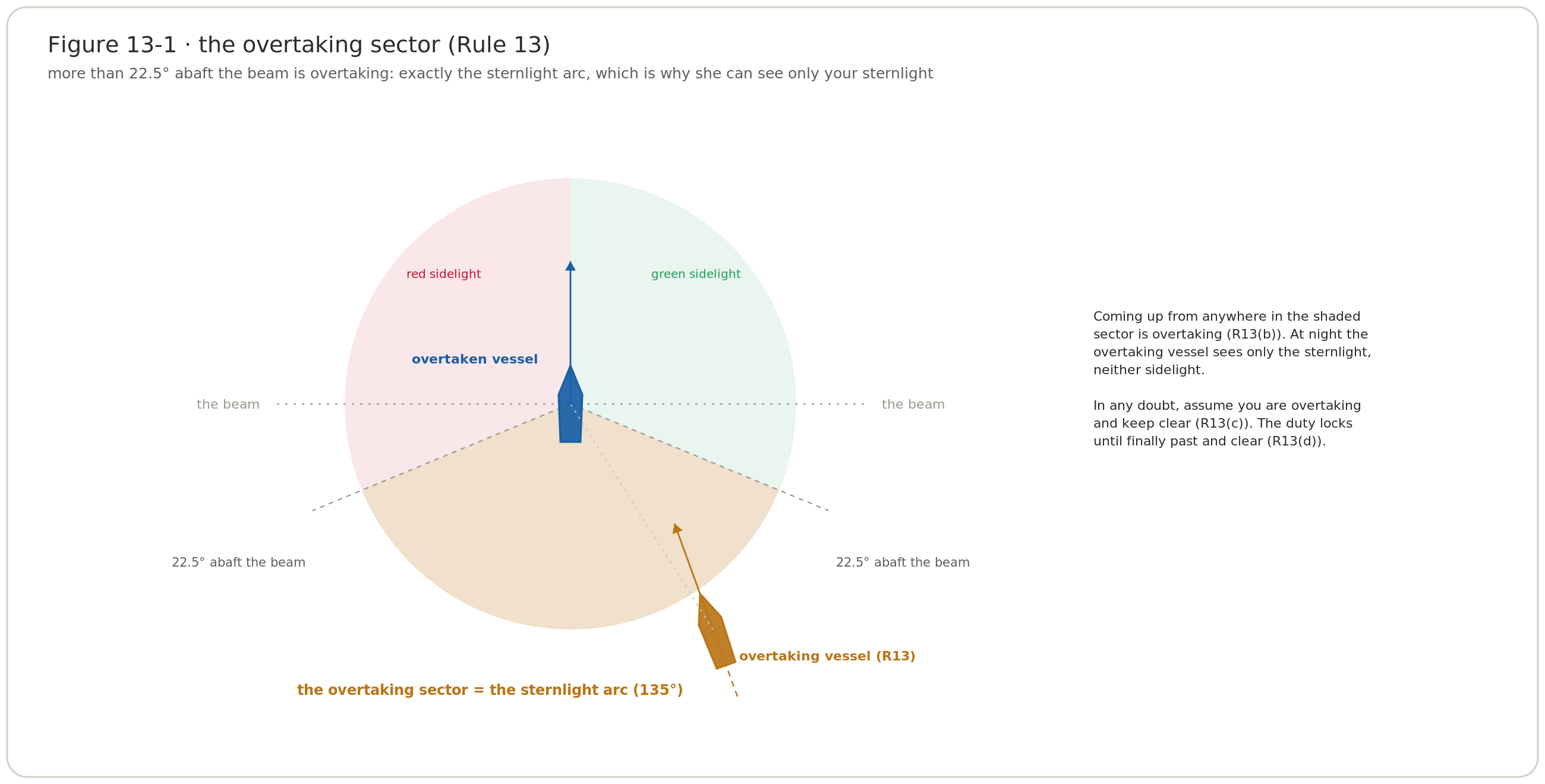
Figure 13-1. The overtaking sector. More than 22.5° abaft the beam is overtaking: exactly the sternlight arc, which is why at night the overtaking vessel sees only your sternlight and neither sidelight. In any doubt, assume you are overtaking (Rule 13(c)).
The proximity question and the overtaking-to-crossing transition are both treated as tensions in Chapter 9. In short: the duty “begins to operate before there is risk of collision and as soon as it can properly be said that the overtaking ship is coming up with the overtaken ship” (Olympian–Nowy Sacz, Court of Appeal, 1977, cited in Cockcroft & Lameijer, 7th ed), so it is proximity-bounded though no distance is stated; and whether a fresh crossing can develop afterwards depends on whether risk of collision existed during the overtaking geometry (Auriga–Manuel Campos, 1977, where vessels passing about three miles off with no risk during the overtaking phase were governed by the crossing Rule for the later situation).
Interactions: Rule 13 overrides Rules 12, 14, 15 and 18 by its opening words, and is itself confined to vessels in sight (so it does not apply in restricted visibility, where Rule 19 governs, Chapter 9); it works with Rule 17(a)(i) (the overtaken vessel stands on) and Rule 9(e) (the narrow-channel overtaking protocol). See: Ch 8 (the overtaking asymmetry), Ch 9 (proximity, transition, and overtaking in restricted visibility).
The rule’s text, word for word and annotated: Rule 13 in Appendix B.
Rule 14: Head-on Situation · FULL
The only encounter Rule that puts identical duties on both vessels: neither is stand-on, neither give-way, and both alter to starboard for a port-to-port passing. A head-on situation is deemed to exist when a vessel sees the other ahead or nearly ahead, by night the masthead lights in or nearly in a line and/or both sidelights (14(b)); and in any doubt she assumes it exists and acts accordingly (14(c)), which pushes the borderline case into the safer default.
DRAFTING ISSUE: no angle for “nearly reciprocal”
The boundary between head-on and crossing is nowhere defined; the courts have looked at differences from a few degrees up, and the IMO has declined to fix a number. The danger is a split classification, one master reading head-on and altering to starboard, the other reading crossing and standing on. The resolution is Rule 14(c): when in doubt, treat it as head-on. Sea Star–Horta Barbosa, 1976, held Rule 14 to apply, and a port-to-port passing to be required, even where the vessels lay slightly starboard-to-starboard, because the courses were reciprocal (Chapter 9).
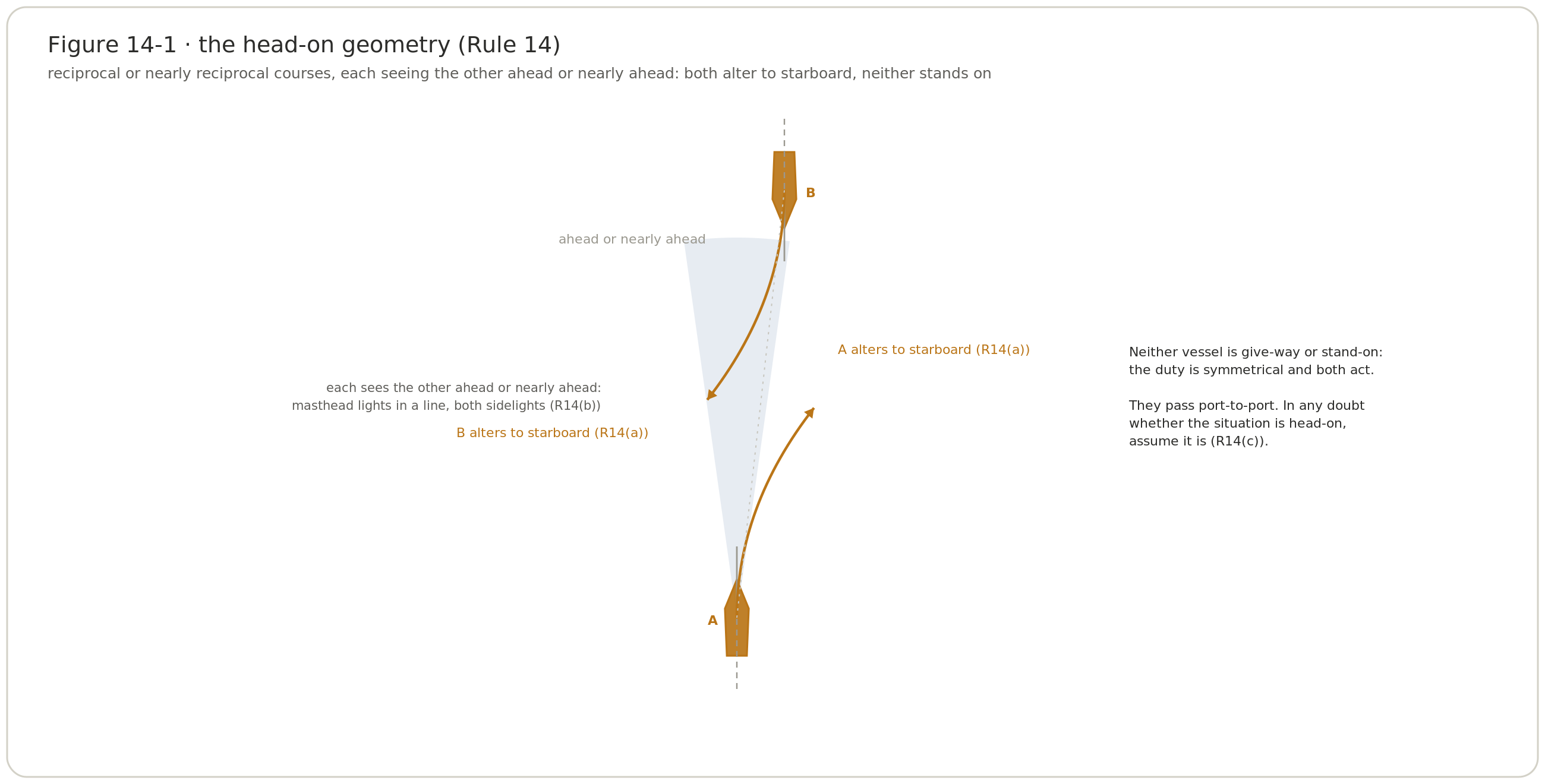
Figure 14-1. The head-on geometry. Reciprocal or nearly reciprocal courses, each seeing the other ahead or nearly ahead: both alter to starboard and pass port to port; neither stands on.
Interactions: Rule 14 is overridden by Rule 13 (an overtaking vessel does not become head-on), requires risk of collision (Rule 7), and is read with Rules 8 and 16 for the manner of the alteration. See: Ch 9 (the nearly-reciprocal problem), Ch 6 (the deeming and doubt provisions).
The rule’s text, word for word and annotated: Rule 14 in Appendix B.
Rule 15: Crossing Situation · FULL
One sentence creates the classic relationship: when two power-driven vessels cross so as to involve risk of collision, the one with the other on her own starboard side keeps out of the way and shall, if the circumstances admit, avoid crossing ahead. So the vessel with the other on her starboard gives way; the other stands on. The give-way vessel carries two obligations: keep out of the way (unqualified), and avoid crossing ahead (qualified by “if the circumstances admit”), which builds in a preference for passing astern.
PRACTICAL NOTE: why crossing ahead is dangerous
To cross ahead is to put your track across the stand-on vessel’s bow, so any error in your estimate of her speed is paid for at her stem. Passing astern makes the same error work in your favour, opening the distance rather than closing it. That is why the Rule, and good seamanship, prefer the turn to starboard that takes you under her stern.
Interactions: Rule 15 is overridden by Rule 13 (overtaking) and Rule 18 (it is between power-driven vessels; a crossing with a privileged class is governed by 18), feeds Rule 16 (give-way action) and Rule 17 (stand-on action), and requires risk of collision (Rule 7). See: Ch 8 (the four stages), Ch 6 (“if the circumstances of the case admit”).
The rule’s text, word for word and annotated: Rule 15 in Appendix B.
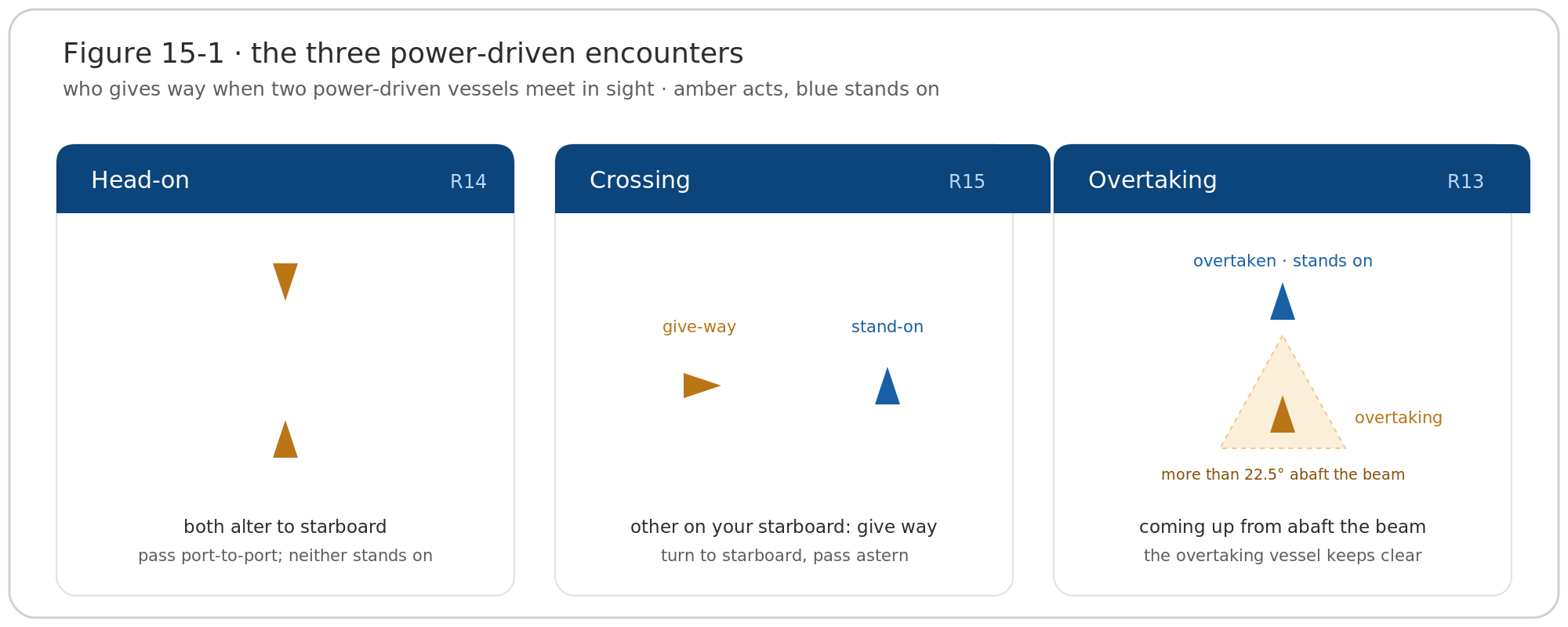
Figure 15-1. The three power-driven encounters. Who gives way when two power-driven vessels meet in sight: head-on (both alter to starboard), crossing (the vessel with the other to starboard gives way), overtaking (the overtaker keeps clear). Amber acts, blue stands on.
Rule 16: Action by Give-way Vessel · FULL
Three words carry the Rule: the give-way vessel shall, so far as possible, take early and substantial action to keep well clear. “Early” and “substantial” rule out the late, timid nudge; “well clear” sets the standard of the result, a stronger demand than the bare “keep out of the way” that names the role; and “so far as possible” relaxes the duty only for genuine impossibility, not inconvenience (Chapter 6).
Interactions: Rule 16 states the action for whichever vessel Rules 12, 13, 15 or 18 designate as give-way, and its manner is governed by Rule 8; it is the counterpart of Rule 17. See: Ch 6 (“so far as possible” and “keep well clear”), Ch 8 (Stage 2).
The rule’s text, word for word and annotated: Rule 16 in Appendix B.
Rule 17: Action by Stand-on Vessel · FULL
Rule 17 is a three-step escalation (the four stages of Chapter 8). The stand-on vessel keeps her course and speed (17(a)(i)), so the give-way vessel has a stable target. She may take action by her own manoeuvre once it becomes apparent that the give-way vessel is not acting appropriately (17(a)(ii)). And she shall take such action as will best avoid collision when the give-way vessel’s action alone can no longer prevent it (17(b)), at which point the restrictions lift. While acting under 17(a)(ii) in a crossing she shall not, if the circumstances admit, turn to port for a vessel on her own port side (17(c)). And nothing in Rule 17 relieves the give-way vessel of her own duty (17(d)).
DRAFTING ISSUE: no threshold between “may” and “shall”
The gap between the permission of 17(a)(ii) and the obligation of 17(b) is where most casualties happen. The stand-on vessel passes from discretion to duty at a moment no number marks: act too early and you may confuse a give-way vessel whose own manoeuvre is just developing; wait too long and you reach the obligation with no room left. Cockcroft’s open-sea guidance puts the permission at a few miles and the duty closer, but it is keyed to vessel size and bears no fixed distance (Chapter 8).
Interactions: Rule 17 is the counterpart of Rule 16; it is engaged by Rules 13, 15 and 18; its “keep course and speed” is protected by Rule 13(d) in a long overtake, and was held not to be an absolute freeze in Windsor–Roanoke, 1908, where a stand-on vessel was justified in stopping her engines to embark a pilot. See: Ch 8 (the four stages), Ch 9 (the escalation timing and the long-overtake tension).
The rule’s text, word for word and annotated: Rule 17 in Appendix B.
Rule 18: Responsibilities Between Vessels · FULL
Rule 18 sets the order of priority between classes of vessel, most to least privileged: not under command, restricted in her ability to manoeuvre, engaged in fishing, sailing, power-driven. A vessel constrained by her draught is not in that keep-out-of-the-way order; she is owed only that others avoid impeding her safe passage (18(d)), and she navigates with particular caution. The opening words are decisive: “except where Rules 9, 10 and 13 otherwise require.” In a narrow channel a small or sailing vessel cannot use Rule 18 against a confined vessel, and when overtaking, Rule 13’s “notwithstanding” overrides the order entirely (Chapter 6).
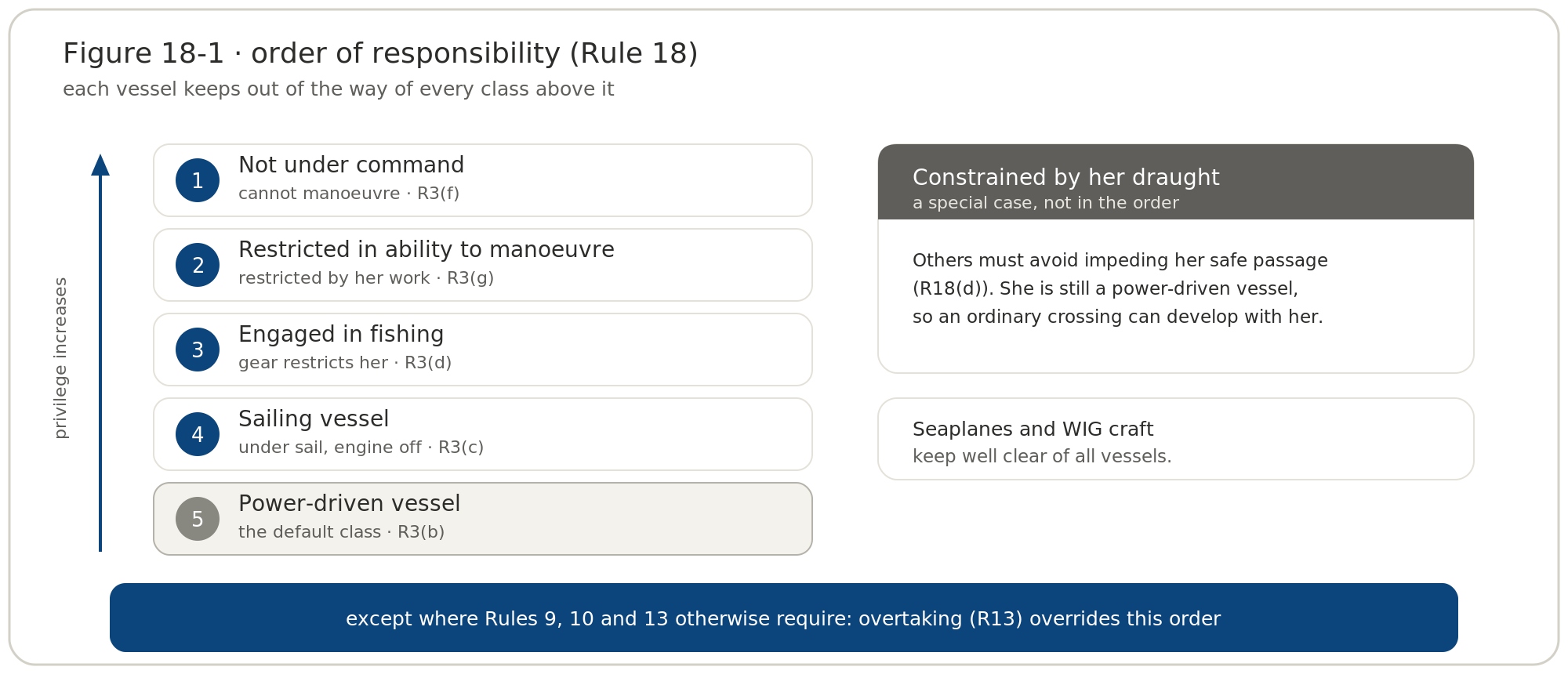
Figure 18-1. The Rule 18 order of responsibility. Each vessel keeps out of the way of every class above it, NUC at the top through to power-driven at the foot, with CBD to one side as a not-impede special case and seaplanes and WIG craft keeping clear of all. The order yields where Rules 9, 10 and 13 otherwise require.
Interactions: Rule 18 yields to Rules 9, 10 and 13 by its own terms, governs which vessel is give-way in a mixed-class encounter (displacing the plain crossing/head-on Rules), and is read with the lights of Part C, which is how the classes are recognised. See: Ch 6 (“except where … otherwise require”), Ch 7 (the vessel classes), Part II Part C (the lights that signal each class).
The rule’s text, word for word and annotated: Rule 18 in Appendix B.
Section III: Conduct of Vessels in Restricted Visibility
Rule 19: Conduct of Vessels in Restricted Visibility · FULL
A wholly different regime from Section II: no stand-on vessel, no give-way vessel, both act independently (Chapter 5). Rule 19 applies to vessels not in sight when in or near restricted visibility (19(a)). Every vessel proceeds at a safe speed adapted to the conditions, with engines ready for immediate manoeuvre (19(b)), and Section I continues in force (19(c)). On detecting a vessel by radar alone, a vessel determines whether a close-quarters situation is developing or risk of collision exists, and if so takes avoiding action in ample time, avoiding so far as possible an alteration to port for a vessel forward of the beam other than one being overtaken (19(d)(i)), and an alteration towards a vessel abeam or abaft the beam (19(d)(ii)). A vessel hearing a fog signal forward of the beam, or unable to avoid close-quarters with a vessel forward of the beam, reduces to bare steerage and navigates with extreme caution (19(e)).
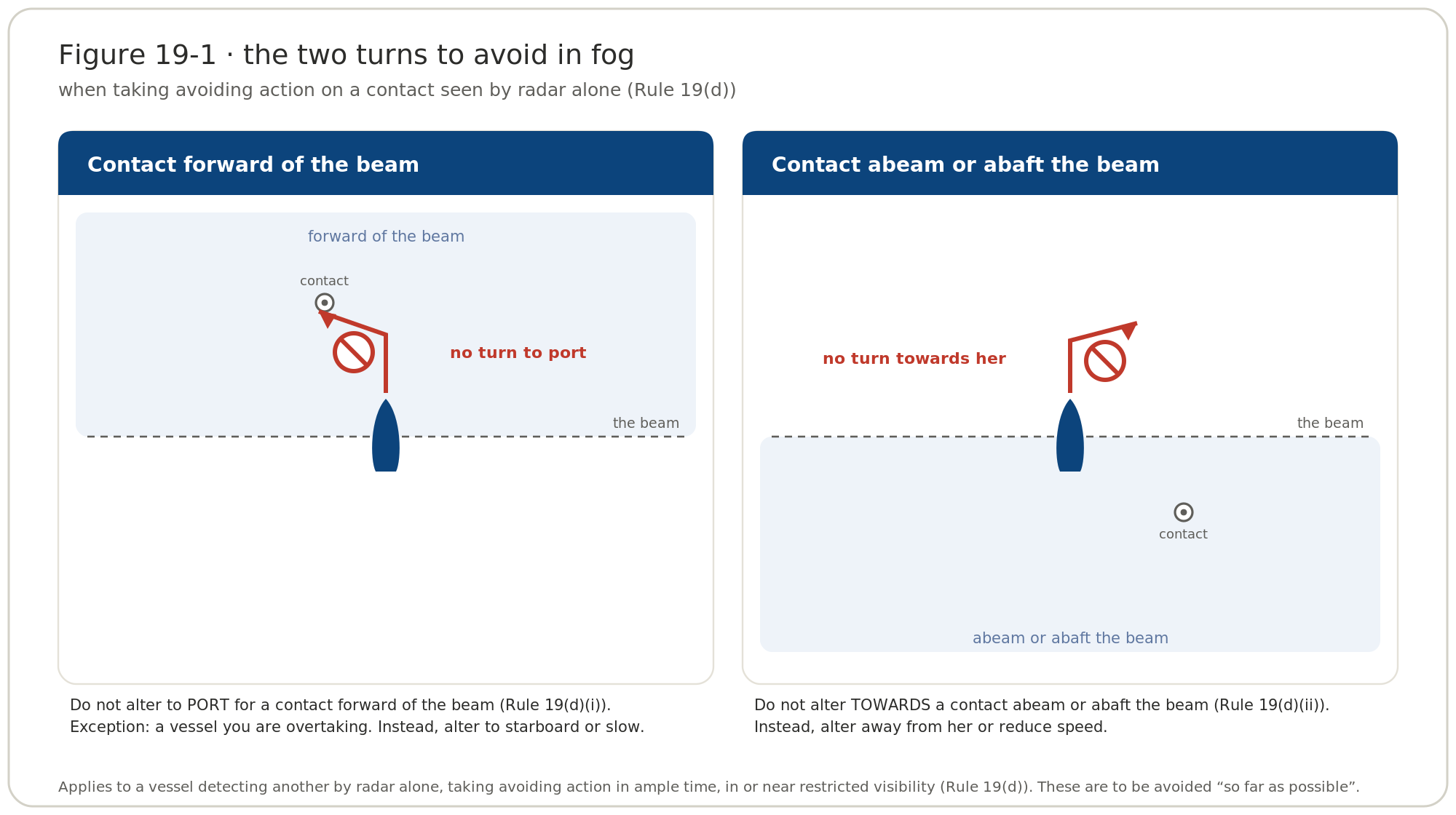
Figure 19-1. The two turns to avoid in fog. When taking avoiding action on a contact held by radar alone, Rule 19(d) rules out an alteration to port for a vessel forward of the beam (other than one being overtaken) and an alteration towards a vessel abeam or abaft the beam; the restrictions are built so that two complying vessels’ actions complement rather than conflict.
TRANSLATION
Rule 19(d)(i) (MISCPUB 0127): action consisting of an alteration of course, so far as possible, shall avoid “an alteration of course to port for a vessel forward of the beam, other than for a vessel being overtaken.”
Plain reading: in fog, don’t turn left towards something ahead of you, unless you’re overtaking it.
What the legal wording does that the plain version can’t: the carve-out “other than for a vessel being overtaken” preserves the one case where a port turn towards a forward contact is sound. It is also the only place the Rules acknowledge overtaking geometry in restricted visibility, where Rule 13 does not reach (Chapter 9).
DRAFTING ISSUE: overtaking referenced without its Rule, and no transition protocol
Rule 19(d)(i) excepts “a vessel being overtaken,” but Rule 13, which defines overtaking, is Section II only and does not apply in fog; the geometric idea has to be carried across by inference. And when visibility lifts at close range, Section II applies instantly, with no grace period for a vessel who manoeuvred lawfully under Rule 19 and now finds herself poorly placed. The port-alteration restriction in 19(d)(i) exists partly to hedge against exactly that (Chapter 9).
Interactions: Rule 19 displaces Section II entirely while vessels are not in sight; it runs on top of Section I (Rules 5–10, especially safe speed and risk of collision); and the directional restrictions of 19(d) are built so that two complying vessels’ actions complement rather than conflict. See: Ch 5 (the visibility-state structure), Ch 9 (the fog-to-Section-II switch and overtaking in restricted visibility).
The rule’s text, word for word and annotated: Rule 19 in Appendix B.